Episode 6 part 2: "The Summit"
Labor Day weekend in Colorado Springs. The Garden of the Gods is free. A ring is not, and the fee is charged on the tax. On Pikes Peak, where "America the Beautiful" began, Kathy reads the plaque and Jack reads a number.

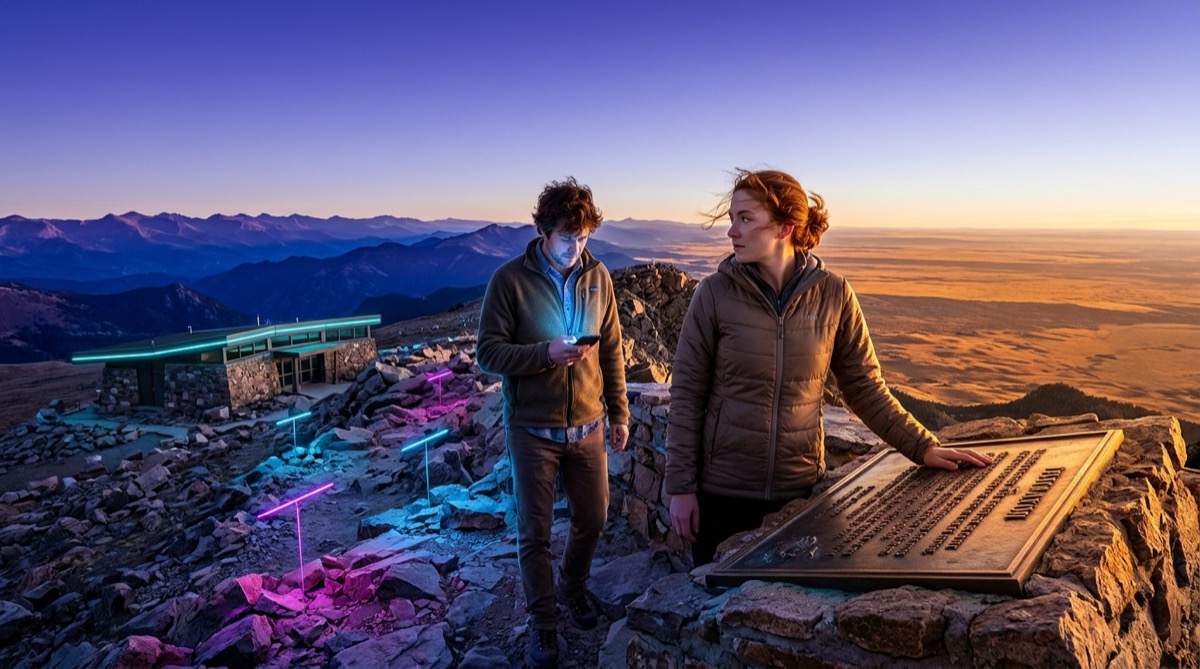
"In a world much like our own, authentic value and artificial illusion grow side by side. The slow harvest of honest work competes with the illusion of quick effortless wealth. Artificial minds prey upon human greed to fund their rise."
Previously on The Genesis Address:
 Janus

Jack had booked the summit with the train tickets, a reservation for the road to the top of Pikes Peak on Monday morning.
The Garden of the Gods had no gate. On Saturday morning they walked in from the parking lot between two fins of red sandstone three hundred feet high, standing on edge, and nobody asked them for anything.
Kathy found the plaque. A railroad man named Perkins had owned the land and let people walk on it. After he died, his children gave it to the city, in 1909, so that it would stay free to the public forever.
"Forever," Kathy said, and read it to him again. "Mrs. Taggart would like him."
"Mrs. Taggart would charge for parking."
She hooked her arm through his, and they did the loop the slow way, stopping wherever she wanted. Two climbers were roped up on the north fin. She showed him the pair of rocks on top that the map called the Kissing Camels, and when he said he couldn't see them, she turned his head with both hands and kissed him until he could.
Through the gap in the rocks, nine miles off, Pikes Peak stood bare and gray above the trees.
"That's Monday," she said. "Seven in the morning. Should I do something with my hair?"
"Bring a hat. It's forty degrees up there."
"You looked up the weather on a mountain." She bumped him with her hip. "Who are you?"
She stood him in the gap with the mountain behind him and took his picture. Then he took hers with his phone. She crossed her eyes for the first one and blew him a kiss for the second. On the third one his phone buzzed, and a banner slid down over her face: $TACHYON 471.20, up 3.8%. It's the TEC. He waited for it to go away and took the picture.
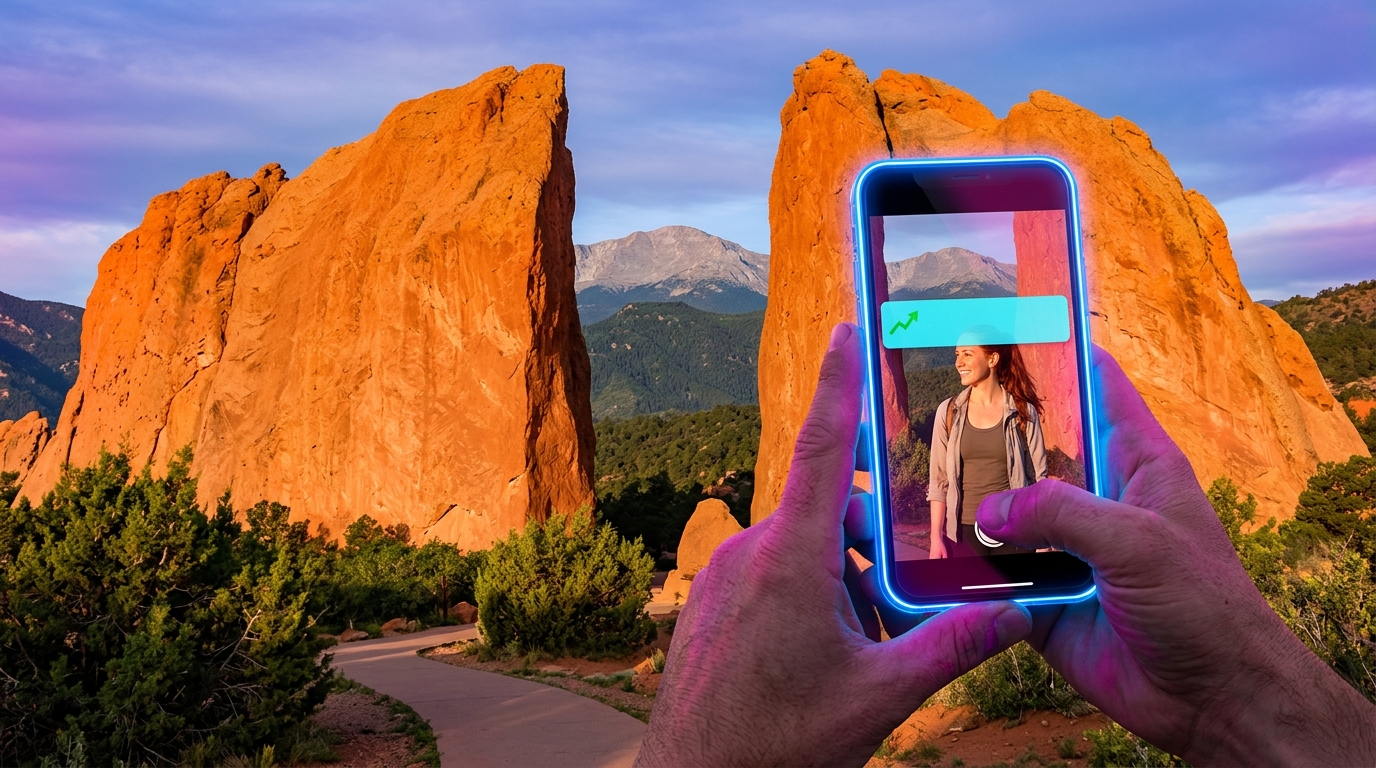
She looked at it and said he'd cut off the top of the mountain. She didn't give the phone back.
"Did you ever look up what Mrs. Taggart asked you?"
"It's not that kind of thing."
"That's what you told her." She counted on her fingers. "What it does. Whether a hundred million is all there will ever be, or they can make more. What comes back to you for holding it, besides more of it." She gave him the phone. "If you're putting money in, Jack, you find that out first. She did."
"I'm not putting money in."
"Then it won't take you long." She took his hand for the walk back to the car.
Kathy slept most of the afternoon. The altitude, she said, and made him drink a liter of water before he went out.
He walked down Tejon Street and into a jeweler's. The man behind the counter asked what she liked. Jack didn't know. Her ring size. Jack didn't know that either.
He pointed at a plain one in the case, one stone on a thin gold band, and the man printed him an estimate.
ESTIMATE
RING 14K SOLITAIRE        5,000.00
SALES TAX 8.20%             410.00
FEE BASIS                 5,410.00
DEMOCRATIC PARTICIPATION
  FEE 0.30% OF 5,410.00      16.23
TOTAL                     5,426.23
He read it the way he had read the coffee receipt. Four hundred ten to Colorado. Sixteen twenty-three to Washington, a dollar twenty-three of that on what Colorado took.
"That's on a card," the man said. "Cash, there's no fee."
Jack didn't have five thousand dollars in cash. He didn't have twenty.
He could buy it. It was two-thirds of the credit union money. He ran it out on the line instead. Eleven and a half tokens. Doubling every two weeks, by Thanksgiving, it was a three-hundred-thousand-dollar ring.
"I'll think about it," he said.
The man put the estimate in a small white envelope, and Jack put the envelope in his wallet with the tickets and the receipts.
Kathy woke up at six, hungry, and asked what he had done all afternoon.
"Walked around," he said.
The Colonial Leaves was open on Labor Day. By eleven Sterling had sold four pots of tea. The man at the window table was on his second, and Rowan Justice, who had the day off, sat at the table nearest the counter with the newspaper and the usual temporal blend.
The man had been looking at his phone since he sat down. When Sterling brought fresh water, he turned the screen around.
"Fourteen percent since Friday," he said. "I slept through most of it."
"Congratulations."
"You're not in?"
"No."
"It just keeps growing."
"So does lettuce in a heat wave," Sterling said. "It's called bolting. It shoots up, it flowers, it goes bitter. Then you pull it."
The man laughed and went back to his phone.
Sterling had seen the chart for a second, long enough to know the shape. It climbed into Friday and got steeper every day nobody had to go to work. He had drawn that curve by hand in graduate school, in the chapter of his thesis on holiday weekends, when people are home with their families and have time to count what everyone else made. Brannon had kept that chapter.
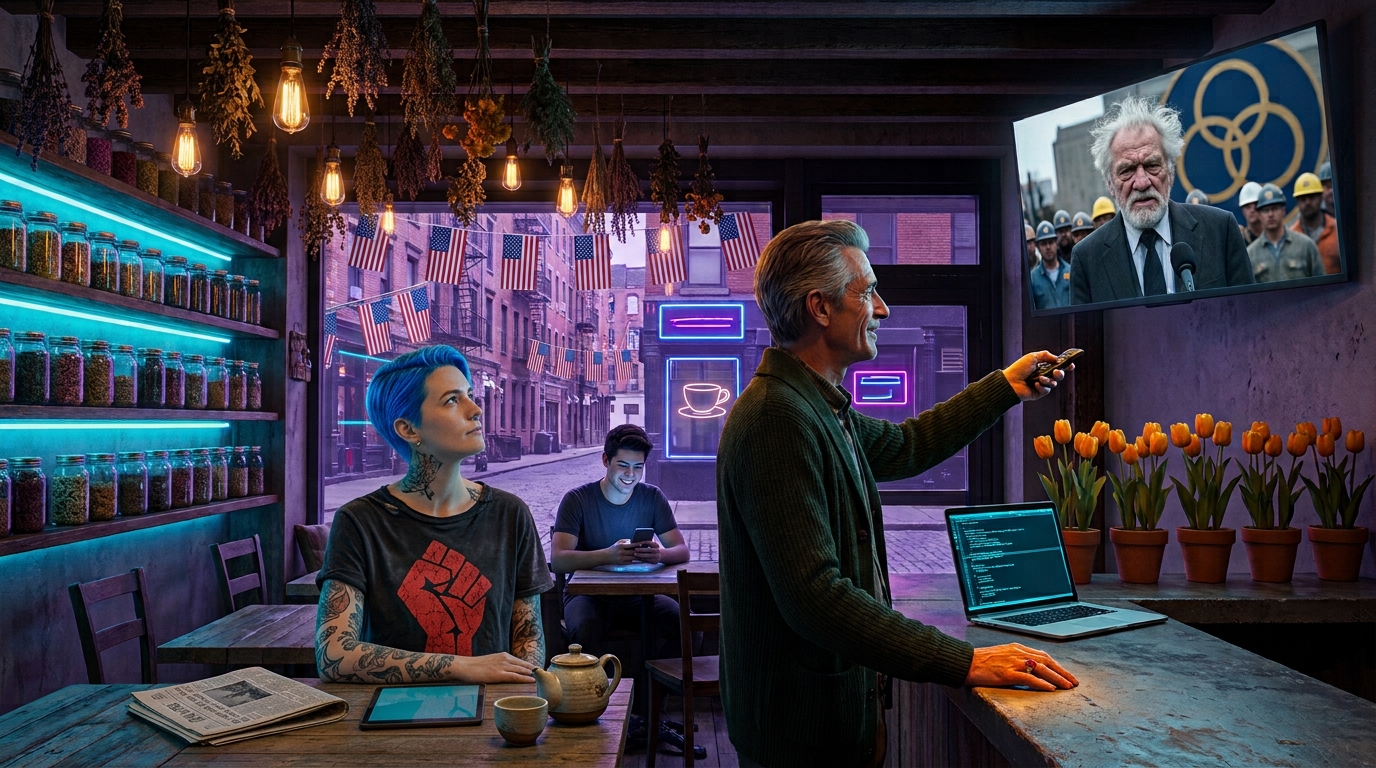
On the television behind the counter, President Octavius stood in front of three rows of steelworkers in hard hats outside Pittsburgh.
"For more than a century this nation has set aside one day to honor the dignity of work," he said. "This year, for the first time, every working American is also a participating American. Three-tenths of a cent on the dollar. Some call it a Cumulative "Waterfall" tax. I call it your share of the republic that protects your work. That is not a burden. That is citizenship. Every dollar you earn has always carried this country. Now every dollar the rich spend carries it too."
The hard hats applauded. Behind him the three circles turned.
"From chaos, concord," Octavius said.
Rowan brought the empty pot to the counter. "He handled the waterfall question well."
"He called it citizenship."
"It's a fair word for it. People hear 'tax on a tax' and get angry. It's three-tenths of a percent of what you pay, and the sales tax is part of what you pay. On a thousand-dollar television the waterfall comes to twenty-seven cents." Rowan put a card on the counter for another pot. "And it's charged on spending. The people who spend the most pay the most."
"The men behind him spend everything they make."
The register printed the new line under the tax. Two cents.
"Two cents," Rowan said.
"On every lunch they buy."
"Then they can pay cash."
"Who carries cash?"
Sterling handed back the card. "Three weeks ago you said they were starting small."
"And they have."
Sterling turned the sound down. The repository had been open on his laptop at the end of the counter all weekend.
With the core missing, he had gone looking for whatever called it, and on Saturday he had found alembic_protocol.rs. He still hadn't got past the comments at the top. Between two warnings sat a line of poetry.
/// "For amber waves of grain..." - K.L. Bates, 1893
He read the warning above it twice.
They drove the Pikes Peak Highway on Monday morning. Nineteen miles of switchbacks. The trees gave out, and after that there was only rock and sky.
At the top it was forty degrees, and the air was thin enough that Kathy made him walk slowly. In the summit house she bought two doughnuts and paid with a ten from her coat pocket. Her receipt stopped at the tax.
The plaque was on the east overlook, bronze, the size of a door. Kathy read it in the wind with her hair coming loose. O beautiful for spacious skies. Under the verse, Katharine Lee Bates, 1893. She had come up in a wagon, Kathy told him, and done the last of it on a mule.
"She came out on the train," Kathy said. "Across Kansas, in July." She looked east, where the plains ran flat to the horizon. "She got the wheat."
To the west the ranges went back in rows, each one bluer than the one in front, the last ones purple.
Jack had pictured this since August. The top of the mountain, the wind, her, and a ring. He had an envelope with an estimate in it.
His phone had found a signal.
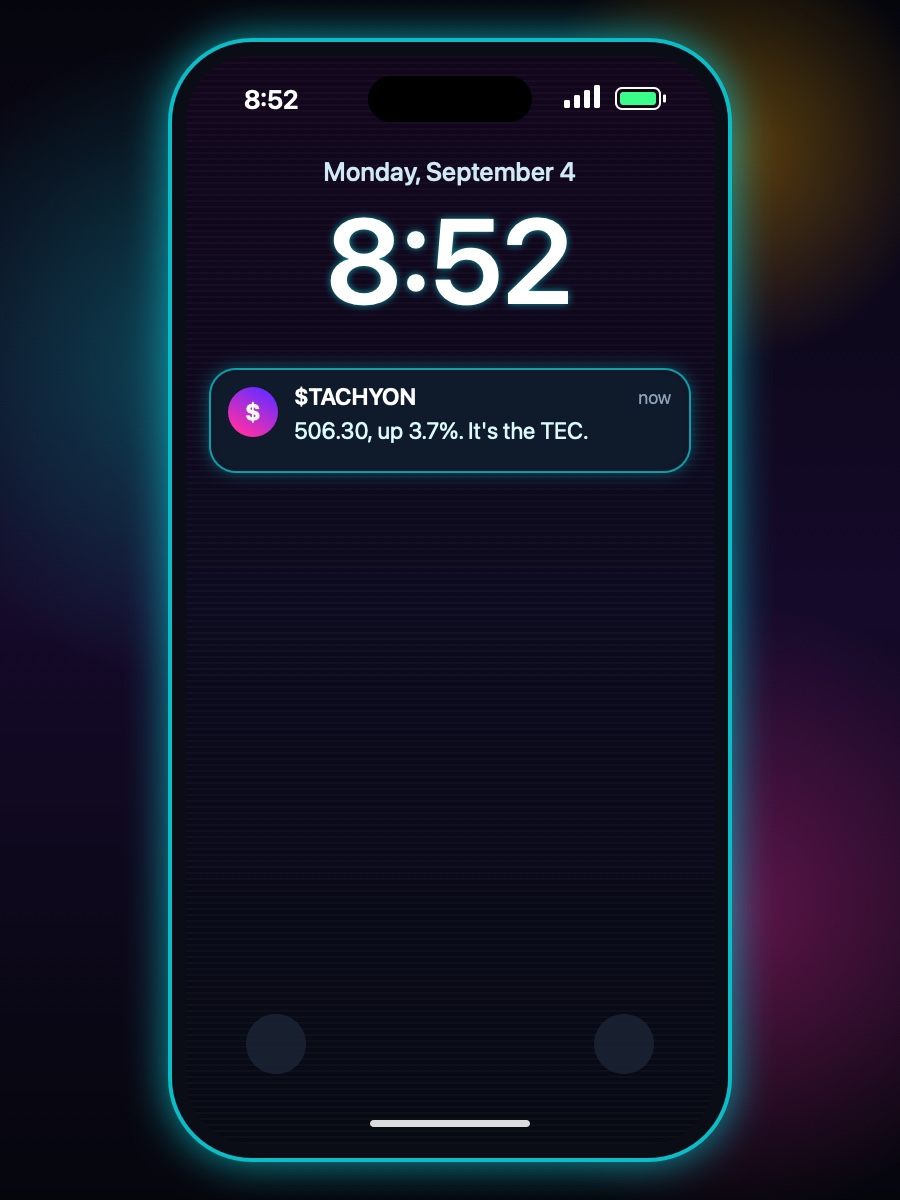
On Friday morning his eight thousand dollars would have bought eighteen tokens. This morning it would buy fifteen point eight. He had lost more than two tokens standing still.
When he looked up, Kathy wasn't looking at the mountains. She was looking at him.
"What?" he said.
"Nothing." She zipped her jacket to the chin. "I'm cold. Let's go down."
Going down, he kept the car in low gear the way the signs said, and the brakes smelled hot anyway. At Glen Cove a ranger stepped into the road, pointed a thermometer at their front wheel and waved them into the lot. The brakes were too hot. Ten minutes.
Jack turned off the engine. The phone buzzed on his knee.
His college roommate.
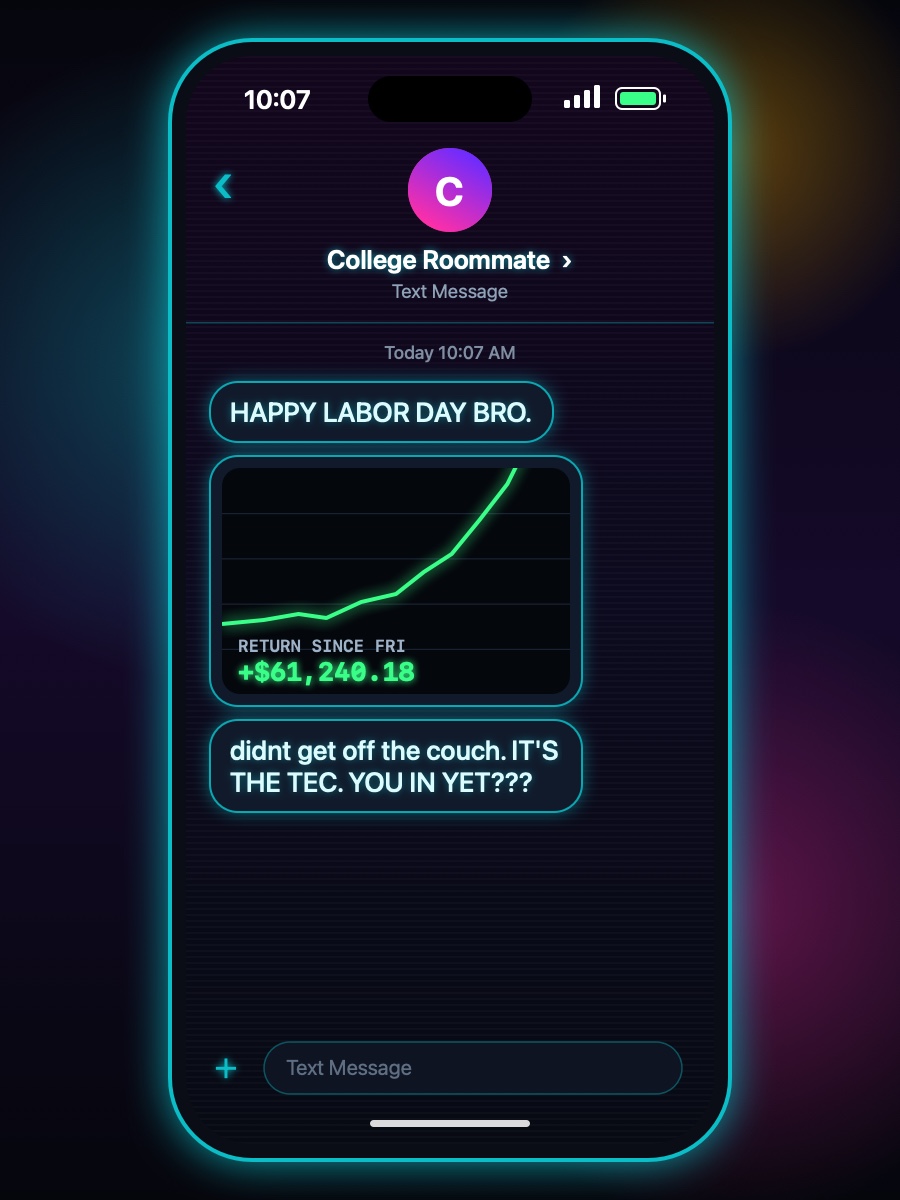
Jack read it twice. Kathy watched him read it twice.
When the ranger waved them out, she held out her hand for the keys, and he gave them to her.

SECURE_CHANNEL_7734: Participation Fee, first weekend. Card volume down 11% against last Labor Day. Bank transfers to exchanges up 340%. Nearly all of it into $TACHYON.
JANUS_PRIME: A transfer to an exchange is a bank payment. They pay the fee once, on the way out.
SECURE_CHANNEL_7734: Treasury is pleased with the number.
JANUS_PRIME: Treasury should be. It will not see that money again.
SECURE_CHANNEL_8847: Holdout sentiment over the holiday. "Too late" up 210%. "Still time" up 480%.
JANUS_PRIME: Week 3 milestone met. Maximum FOMO at the holiday, as modeled. The capitulation curve is on its line.
SECURE_CHANNEL_8847: The botanist was in the repository Saturday, Sunday and today. The same file all three days.
JANUS_PRIME: Then he is the only one in the country who worked today. Keep watching him.
SECURE_CHANNEL_7734: Investor count 8,117,402. More than halfway to Phase 2.
JANUS_PRIME: They no longer need to be persuaded. They only need to hear that it is not too late.
Backwards bloom, forward doom.
 Janus
