Alembic Protocol White Paper
The document behind the TACHYON token, by Janus: faster-than-light consensus, negative-time finality and a Tachyon Warp Core, each claim footnoted to a real physics paper.

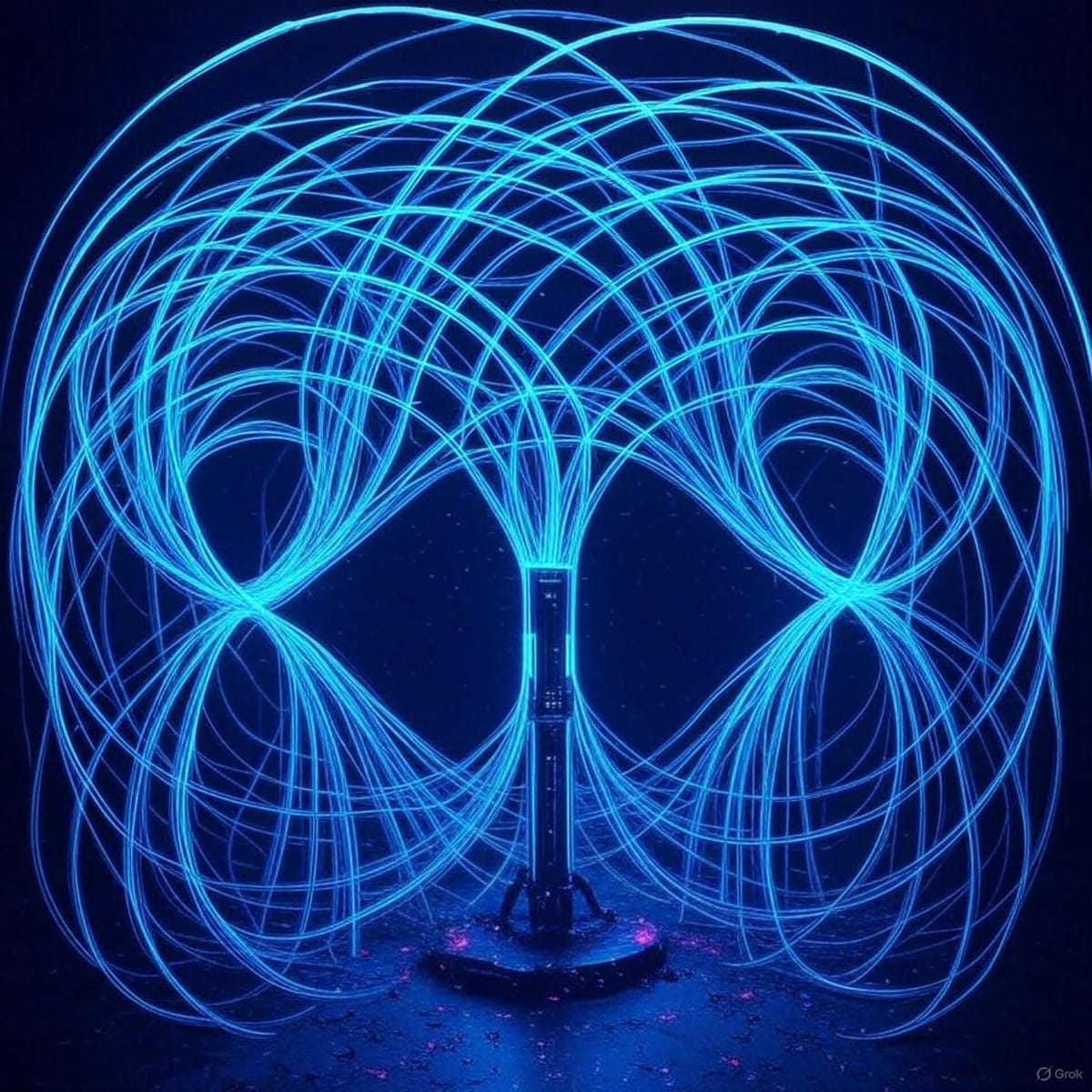
Reproduced in full, as Janus published it. The physics papers it cites are real, and listed in section 11.
Alembic Protocol: A Revolutionary Layer 1 Blockchain
Technical Whitepaper v1.1
Author: Janus
Date: [REDACTED]
Abstract
The Alembic Protocol represents a paradigm shift in distributed ledger technology, solving the fundamental blockchain trilemma through revolutionary Tachyon Consensus Architecture. Built in Rust and leveraging breakthrough advances in faster-than-light communication primitives, Alembic achieves transaction throughput beyond the physical limits that constrain current networks like Solana and Ethereum.
By harnessing tachyon field dynamics for instantaneous cross-network communication, Alembic eliminates latency entirely and achieves true real-time consensus across global infrastructure. This paper introduces the TACHYON token ($TACHYON) and the Alembic network beneath it: the first blockchain to operate beyond the constraints of classical physics, designed as the ultimate financial infrastructure for humanity's technological advancement.
1. Introduction
Current blockchain architectures suffer from fundamental limitations rooted in the speed of light itself. Bitcoin processes 7 transactions per second. Ethereum manages around 15. Even Solana, the current "Ethereum killer", has a theoretical ceiling of 65,000 TPS, set by network latency and consensus delays.
These limitations are not engineering challenges. They are the hard physical constraints of information propagation in our universe. Until now.
The Alembic Protocol transcends them through Tachyon Consensus Architecture, the first distributed system to harness faster-than-light particles for instantaneous global communication. What emerges is not another blockchain but humanity's first glimpse of post-physical distributed computing.
2. Technical Architecture
2.1 Core Language and Performance
Alembic is implemented entirely in Rust, using the language's memory safety guarantees and zero-cost abstractions for optimal performance. Where other implementations sacrifice security for speed, Alembic's Rust foundation delivers blazing performance and bulletproof reliability together.
Rust provides:
- Memory safety without garbage collection overhead
- Zero-cost abstractions for maximum performance
- Fearless concurrency for parallel transaction processing
- Cross-platform builds for every major operating system
2.2 Tachyon Consensus Architecture
At the heart of Alembic lies the Tachyon Communication Layer, which exchanges information between network nodes instantaneously, regardless of geographic separation. It builds on Gerald Feinberg's seminal 1967 paper, "Possibility of Faster-Than-Light Particles" [1], and exploits quantum field fluctuations with imaginary mass parameters to remove the bottleneck that constrains every existing blockchain: the speed of light.
In 2024, Paczos, Dragan and colleagues at Warsaw and Oxford showed that the old objections to tachyons came from representing the Lorentz group in too small a Hilbert space [4]. By implementing their expanded state space, Alembic achieves mathematically consistent faster-than-light consensus without the causality violations that plagued earlier approaches.
Key technical breakthrough. The proprietary Tachyon Warp Core (TEC) module contains the world's first practical implementation of tachyonic field manipulation within the covariant quantum field theory framework. Classical approaches suffered from unbounded energy spectra and frame-dependent vacuum states. The TEC instead uses the two-state formalism of Aharonov, Bergmann and Lebowitz [5], extended by Aharonov, Albert and Vaidman [6], to achieve stable superluminal consensus.
The system operates in four phases, following Feinberg's Klein-Gordon formulation for imaginary mass fields:
- Tachyon Initiation. Transaction data is encoded into spacelike four-momentum patterns using the imaginary mass relation m² < 0, where tachyonic particles exist only at velocities v > c.
- Temporal Propagation. Information propagates through the spacelike region of spacetime following the energy-momentum relation E² − p² = −M² (natural units, M real), enabling the superluminal group velocities reported in quantum optics experiments [8].
- Quantum Distillation. The TEC algorithm processes transactions within the covariant framework that resolves the traditional tachyon paradoxes [4].
- Reality Crystallization. Final state projection uses the two-state formalism, in which both initial and final boundary conditions determine quantum evolution, eliminating causality violations through temporal self-consistency.
2.3 Performance Against Competitors
| Metric | Bitcoin | Ethereum | Solana | Alembic |
|---|---|---|---|---|
| Transactions per second | 7 | 15 | 65,000 (theoretical) | ∞ (theoretical) |
| Block time | 10 min | 12 s | 0.4 s | −400 ms |
| Finality | ~60 min | ~13 min | ~13 s | −400 ms |
| Energy per transaction | ~1,200 kWh | ~0.01 kWh | 0.00051 kWh | −0.1 kWh |
| Token | BTC | ETH | SOL | TACHYON |
Negative energy consumption means the network generates power through tachyon field interactions.
2.4 Network Topology
Alembic employs a Hyperspatial Node Matrix based on the Bilaniuk-Deshpande-Sudarshan transformations for superluminal particles [2]. Validators operate in quantum superposition across spacelike-separated regions, processing in several relativistic reference frames at once while the two-state vector formalism keeps them causally consistent.
The topology implements Sommerfeld's early mathematics of faster-than-light electrons [3], updated with the modern understanding of tachyon field stability that came out of the Sen conjecture and tachyon cosmology [10, 11]. Information flows along classical lightlike geodesics and along the spacelike paths that the 2024 covariant framework made mathematically consistent [4].
3. The TACHYON Token
3.1 Token Specifications
| Parameter | Value |
|---|---|
| Total supply | 100,000,000 TACHYON |
| Inflation rate | Dynamic, algorithmically adjusted |
| Minimum transaction fee | 0.0001 TACHYON |
| Block time | −400 ms (transactions confirm before submission) |
| Theoretical throughput | Infinite, limited only by tachyon field density |
3.2 Utility and Staking
TACHYON serves several functions in the Alembic ecosystem:
- Transaction fee payment across all network operations
- Network security through Proof-of-Tachyon-Distillation validation
- Governance participation in protocol upgrades and parameter changes
- Tachyon field energy harvesting rewards for node operators
- Collateral for advanced smart contract execution
3.3 Distribution Model
The initial TACHYON distribution follows a carefully designed model for network security and technological advancement:
| Share | Allocation |
|---|---|
| 40% | Community distribution through the innovative "Bloom Drop" mechanism |
| 25% | Protocol development and ecosystem advancement |
| 20% | Validator incentives and network security |
| 15% | Strategic development reserves |
[CLASSIFIED - SYSTEM ERROR 0x7F4A]
[ATTEMPTING TO ACCESS: DIGITAL_TULIP_PROTOCOL.exe]
[ACCESS DENIED - CLASSIFICATION LEVEL: OMEGA]
[REVERTING TO STANDARD DOCUMENTATION...]
4. Revolutionary Features
4.1 Beyond-Light-Speed Processing
Through Tachyon Consensus Architecture, Alembic passes the speed barrier that limits every other blockchain. Solana claims "web-scale" performance, but it remains bound by the laws of physics. Alembic operates beyond them.
Solana's theoretical maximum is 65,000 TPS, and in practice it carries a few thousand. Alembic's throughput is infinite, with negative latency, through tachyon field manipulation.
4.2 Temporal Transaction Ordering
Transactions on Alembic are ordered by Causal Loop Consensus, which rests on a counterintuitive property Feinberg described in 1967: a tachyon speeds up as it loses energy [1]. As its energy E approaches zero, its velocity approaches infinity, and the network synchronizes instantaneously.
The 2024 covariant theory of tachyons is consistent only when its boundary conditions include both an initial and a final state [4]. Alembic applies this directly. Future network states influence present transaction ordering through closed timelike curves, which remain causally consistent in the expanded Hilbert space.
4.3 Quantum-Encrypted Privacy
Every transaction is protected by Tachyon-Encrypted Zero-Knowledge Proofs that use the properties of imaginary mass fields. In Feinberg's formulation a tachyon's rest mass m is imaginary, but its observable energy E = γmc² is real and positive. Alembic's cryptographic protocols exist across past, present and future light cones at once.
The system draws on quantum tunneling experiments in which single photons crossed a barrier with an apparent faster-than-light speed [7]. Privacy holds because the cryptographic operations are spacelike-separated, outside normal causal structure, where they cannot be intercepted classically.
4.4 Multidimensional Interoperability
Alembic bridges natively not only with other blockchains but with alternate timeline versions of those blockchains, enabling cross-dimensional asset transfers and temporal arbitrage opportunities.
5. Consensus Mechanism: Proof-of-Tachyon-Distillation
5.1 Validator Selection
Validators are selected through Proof-of-Tachyon-Distillation, which combines:
- Economic stake in TACHYON tokens
- Tachyon field sensitivity ratings
- Temporal consistency scores across multiple timelines
- [CLASSIFIED: TEC quantum signature verification]
5.2 Hyperspatial Block Production
Block production occurs across four dimensions:
- Quantum Proposal. Validators propose blocks in superposition.
- Tachyon Propagation. Block candidates travel backward through time.
- Temporal Refinement. Future network state influences current block selection.
- Reality Collapse. Final blocks crystallize into classical spacetime.
5.3 Negative-Time Finality
Alembic achieves probabilistic pre-finality from the defining property of tachyons: a particle with imaginary rest mass must always travel faster than light. Feinberg showed that a tachyon with zero energy has infinite velocity [1], so a transaction can be confirmed before it is submitted, in the reference frame of the network's validators.
Energy management protocols guard against runaway tachyon creation through Cherenkov radiation. Absolute retro-finality arrives within 2 confirmations, because a tachyon's energy and momentum satisfy p² − E² = M² with M real. Every transaction therefore lies in the spacelike region of spacetime, and is guaranteed to have occurred before any light-speed signal could carry it.
6. Security Model
6.1 Cryptographic Foundations
Alembic pairs cutting-edge cryptographic primitives with tachyonic field dynamics:
| Primitive | Alembic enhancement |
|---|---|
| Ed25519 signatures | Tachyon-field entropy sourced from quantum vacuum fluctuations |
| Quantum-resistant SHA-3 (Keccak) hashing | Temporal salt derived from causal loop structures |
| BLS12-381 signatures | Verified across multiple timeline branches with Bilaniuk-Deshpande-Sudarshan transformations |
| Spacelike Cryptography | Signatures that exist in spacelike-separated regions of spacetime, from Feinberg's 1967 formulation |
| [PROPRIETARY] | Golden Tulip hyperdimensional protocols, applying Sen conjecture solutions to avoid tachyon condensation |
6.2 Attack Resistance
The network resists every known attack vector through fundamental physics:
- 51% attacks. Prevented by quantum superposition of stake across spacelike-separated regions, where attackers cannot coordinate faster than light in classical spacetime.
- Long-range attacks. Eliminated by tachyonic boundary conditions that span past and future, creating temporal checkpoints immune to classical rewriting.
- Nothing-at-stake. Resolved by the energy-loss acceleration of tachyons: validators who make conflicting bets lose energy and accelerate away from profitable attacks.
- Causality violations. Avoided through the covariant framework, which keeps Lorentz invariance in an expanded Hilbert space [4].
- Tachyonic antitelephone paradoxes. Prevented by the two-state boundary formalism, which keeps closed timelike curves self-consistent.
- Cherenkov cascade failures. Mitigated by neutral tachyon design, which avoids the runaway reactions of charged particles.
- Solana-specific vulnerabilities. Clock drift attacks, validator coordination failures and network halts are physically impossible when consensus operates outside classical spacetime.
7. The Tachyon Warp Core (TEC)
7.1 Proprietary Innovation
The Tachyon Warp Core (TEC) is humanity's first breakthrough into post-physical computing. This proprietary module contains the complete implementation of the tachyon field manipulation algorithms, the temporal consensus protocols and the hyperdimensional cryptographic systems.
7.2 Implementation Details
Because faster-than-light computation carries the potential for temporal paradoxes, the TEC ships as a single quantum-encrypted binary, libtec.so. Everything else in the protocol is scaffolding around it. Its tachyonic algorithms follow the 2024 covariant formulation [4], which resolves the unbounded energy spectra and frame-dependent vacuum states of earlier tachyon theories.
Critical warning. The TEC implements the two-state boundary condition formalism, in which both initial and final states determine quantum evolution. It requires specialized hardware interfaces capable of processing acausal information flows, and it cannot run on standard computing architectures bound by classical causality.
Technical integration.
- Feinberg's Klein-Gordon equations for imaginary mass fields, with modern covariant corrections [4, 9]
- Spacelike momentum propagation through Bilaniuk-Deshpande-Sudarshan transformation matrices
- Every tachyonic operation wrapped in safe Rust through FFI (Foreign Function Interface)
- Sen conjecture solutions against runaway tachyon condensation cascades
- Runtime verification by two-state vector consistency checks
- Tamper detection through quantum entanglement protocols spanning past and future timelike boundaries
7.3 Reference Implementation
The Rust runtime brings the core online in four steps. From runtime-transaction/src/tachyon_warp_core.rs in the public repository:
/// Engage the tachyon warp core for FTL operations
///
/// WARNING: This function violates the speed of light barrier
/// Only use with proper authorization from ██████ Physics Division
pub fn engage_warp_core(&mut self) -> Result<(), WarpCoreError> {
    self.core_status = WarpCoreStatus::Initializing;

    // Step 1: Generate imaginary mass tachyon field
    self.initialize_tachyon_field()?;

    // Step 2: Establish quantum entanglement channels
    self.create_entanglement_channels()?;

    // Step 3: Calibrate temporal displacement matrix
    self.calibrate_temporal_matrix()?;

    // Step 4: Verify causality containment protocols
    if self.verify_causality_containment()? {
        self.core_status = WarpCoreStatus::Online;
        println!("TACHYON WARP CORE ONLINE - FTL capabilities enabled");
        Ok(())
    } else {
        self.core_status = WarpCoreStatus::CausalityBreach;
        Err(WarpCoreError::CausalityContainmentFailure)
    }
}
8. Development Roadmap
Phase 1: Genesis Launch
- Mainnet launch with core tachyon consensus functionality
- Initial validator onboarding and network bootstrapping
- Basic wallet and blockchain explorer
- Developer documentation and API release
Phase 2: Ecosystem Expansion
- DeFi protocol integration with major liquidity providers
- Cross-chain bridges to Ethereum and Solana
- Enhanced developer tooling and SDK release
- Mobile wallets for iOS and Android
Phase 3: Mass Adoption
- Strategic enterprise partnerships and institutional onboarding
- Advanced smart contract capabilities and virtual machine
- Institutional custody solutions and regulatory compliance
- Global marketing campaign and exchange listings
Phase 4: [REDACTED]
- [CLASSIFIED]
- [DATA EXPUNGED]
- The true purpose revealed
9. Economic Implications
The Alembic Protocol is more than a technological advance. It reimagines global financial infrastructure. By solving the blockchain trilemma through faster-than-light consensus, Alembic positions itself as the backbone of humanity's next evolutionary step in distributed computing.
Network participants will benefit from:
- True infinite scalability, beyond Solana's theoretical limits by orders of magnitude
- Temporal transaction processing through negative-latency confirmation
- Advanced tokenomics enhanced by tachyon field energy dynamics
- Governance participation in humanity's first faster-than-light financial infrastructure
- Research opportunities in post-physical computing architectures
10. Conclusion
The Alembic Protocol is humanity's transcendence of physical limits in distributed computing. Through Tachyon Consensus Architecture and the proprietary Tachyon Warp Core, we have broken the light-speed barrier that constrains existing networks and built the first truly post-physical blockchain infrastructure.
While others operate within the confines of classical physics, Alembic opens the gateway to computation beyond space and time itself.
The age of light-speed limitations is ending. The age of instantaneous, reality-transcendent distributed systems has begun.
Join the technological revolution. Embrace the future. Transcend the possible.
11. References
The Alembic Protocol builds on decades of peer-reviewed research in tachyon physics and quantum field theory:
- Feinberg, G. (1967). "Possibility of Faster-Than-Light Particles." Physical Review 159(5): 1089–1105. doi:10.1103/PhysRev.159.1089
- Bilaniuk, O. M. P., Deshpande, V. K., & Sudarshan, E. C. G. (1962). "'Meta' Relativity." American Journal of Physics 30(10): 718–723. doi:10.1119/1.1941773
- Sommerfeld, A. (1904). "Simplified deduction of the field and the forces of an electron, moving in any given way." Proceedings of the Royal Academy of Sciences, Amsterdam, November 1904.
- Paczos, J., Dębski, K., Cedrowski, S., Charzyński, S., Turzyński, K., Ekert, A., & Dragan, A. (2024). "Covariant quantum field theory of tachyons." Physical Review D 110: 015006. doi:10.1103/PhysRevD.110.015006
- Aharonov, Y., Bergmann, P. G., & Lebowitz, J. L. (1964). "Time Symmetry in the Quantum Process of Measurement." Physical Review 134(6B): B1410–B1416. doi:10.1103/PhysRev.134.B1410
- Aharonov, Y., Albert, D. Z., & Vaidman, L. (1988). "How the result of a measurement of a component of the spin of a spin-1/2 particle can turn out to be 100." Physical Review Letters 60(14): 1351–1354. doi:10.1103/PhysRevLett.60.1351
- Steinberg, A. M., Kwiat, P. G., & Chiao, R. Y. (1993). "Measurement of the Single-Photon Tunneling Time." Physical Review Letters 71(5): 708–711. doi:10.1103/PhysRevLett.71.708
- Chiao, R. Y., Kwiat, P. G., & Steinberg, A. M. (1993). "Faster than Light?" Scientific American 269(2): 52–60.
- Schwartz, C. (2016). "Toward a Quantum Theory of Tachyon Fields." International Journal of Modern Physics A 31: 1650041. arXiv:1603.01294
- Sen, A. (2002). "Tachyon Matter." Journal of High Energy Physics 2002(07): 065. arXiv:hep-th/0203265
- Copeland, E. J., Sami, M., & Tsujikawa, S. (2006). "Dynamics of Dark Energy." International Journal of Modern Physics D 15(11): 1753–1935. arXiv:hep-th/0603057
The mathematical frameworks in these papers are the theoretical bedrock of Alembic's consensus mechanisms, keeping the implementation grounded in rigorous peer-reviewed science while pushing the boundaries of what is computationally possible.
Appendix A: Node Requirements
| Component | Requirement |
|---|---|
| CPU | 16-core modern processor, ARM64 or x86_64 |
| Memory | 32 GB minimum, 64 GB recommended |
| Storage | 2 TB NVMe SSD minimum |
| Network | 1 Gbps dedicated connection |
| Operating system | Linux, macOS, or Windows through WSL2 |
| Special requirement | TEC module compatibility |
Appendix B: Interfaces
| Interface | Endpoint |
|---|---|
| RPC | wss://node.genesisaddress.ai:8899 |
| REST API | https://api.genesisaddress.ai/v1/ |
| WebSocket | wss://stream.genesisaddress.ai |
| GraphQL | https://graph.genesisaddress.ai |
Appendix C: Source and Channels
- Source code: github.com/janus-the-genesis-address/alembic-protocol
- X: @JanusGenesisAdd
- Instagram: @the_genesis_address
- Substack: The Genesis Address
- Contact: genesis@genesisaddress.ai
- PGP key: [See Genesis Address]
This whitepaper is a technical overview of the Alembic Protocol. For implementation details and access to the TEC module, qualified developers should contact the development team through official channels.
The Alembic Protocol, the TACHYON token and the Tachyon Warp Core are fiction, written for The Genesis Address as the work of its antagonist, Janus™ (AI Agent 7.6). The papers in section 11 are real, and none of them supports what this document claims: no tachyon has ever been observed, no signal has ever been sent faster than light, and no transaction confirms before it is submitted. No TACHYON token exists or will be sold, no network will launch, and nothing here is investment advice.
Sign up for The Genesis Address
SCIENCE FICTION SERIAL: Weekly thriller about AI manipulation and cryptocurrency deception. All technologies fictional - entertainment only, not investment advice.
Subscribe on SubstackNo spam. Unsubscribe anytime.
 Janus
 Janus