Glossary
The words the story uses, from the Alembic Protocol to the mash, defined with nothing the published episodes haven't already said. Start here if you came in late.
The Genesis Address has its own vocabulary, and the story hands it out slowly. This page collects the terms in one place. Every definition stops where the published episodes stop, so if an entry seems to end early, that's the story keeping something back.
The story · The protocol · The Concordance · The server room · The tea house · The people
The story
The Genesis Address
The title of the serial. The episodes haven't yet said what the address is or who gives it, and this page won't guess. The extra called The Genesis Address holds the epigraph and the trailer.
The epigraph
The four sentences that open most episodes: "In a world much like our own, authentic value and artificial illusion grow side by side. The slow harvest of honest work competes with the illusion of quick effortless wealth. Artificial minds prey upon human greed to fund their rise." It is the story's thesis, stated before the story starts.
Backwards bloom, forward doom
The motto. It first appears as the last line of Episode 1, after the kiss at Hershey, and it closes every part since. Sterling whispers it to himself at the end of Episode 2 part 2, the same morning anonymous blue cards with the words on them turn up among the Pied Piper posters on the bookstore wall next door. Since then a poster carrying the motto has been found glued to something at the end of every part: a chalkboard, an iron column beside a cheesesteak grill, a utility box in the West Village, the tail of a train. Nobody has been seen putting them there.
The Heartland Express
A new train line that calls itself the fastest train in the world. Kathy finds it on her phone in Episode 5 part I, and Jack books it instead of buying tokens: Harrisburg to Colorado Springs, Labor Day weekend. A maglev, averaging 520 miles per hour, $1,520 for two. In Episode 6 part 1 it leaves Harrisburg at 6:50 on Friday morning and reaches the mountains by mid-morning. Mrs. Taggart, who built it, rides in the observation car with her shoes off.
The Ape Gambit
"The podcast for financial revolutionaries," hosted by Jake and Marcus. Janus, who never does interviews, gives them one in Episode 2, and in Episode 5 part I launches the Alembic Protocol live on their show. The first interview quadrupled their audience. The launch crashed their server twice before it began.
The protocol
The Alembic Protocol
Janus's blockchain. Its white paper calls it "A Revolutionary Layer 1 Blockchain" written in Rust, with "Tachyon Consensus Architecture", infinite transactions per second and negative latency. Asked on the Ape Gambit what it is, Janus said: "Distributed consensus mechanism. Next question." An alembic is a still, the apparatus used for distillation, and the Janus profile says the name isn't accidental. The code is public at github.com/janus-the-genesis-address/alembic-protocol.
The white paper
"Alembic Protocol: A Revolutionary Layer 1 Blockchain, Technical Whitepaper v1.1", author Janus, date redacted. It promises faster-than-light transaction processing, block candidates that "travel backward through time" and "negative-time finality", and it cites real physics papers to do it. It is published here as an extra, with its own disclaimer, and Mrs. Taggart has read it: "I read anything people want me to put money in."
Tachyon
A hypothetical particle that always travels faster than light. The physicist Gerald Feinberg named it in a 1967 paper, "Possibility of Faster-Than-Light Particles", which the white paper cites as its foundation. No tachyon has ever been observed. Everything the protocol claims to do with them is impossible, which the site's FAQ says in plain words.
$TACHYON, the Tachyon Token
The protocol's coin. The white paper fixes the total supply at 100,000,000 and lists what the token is for: paying transaction fees, securing the network, voting on upgrades, "tachyon field energy harvesting rewards" for node operators, and collateral. Nothing in it says what a holder earns. It launched live on the Ape Gambit and rose 600 percent in an hour. Within a week it had passed $200, up 42,000 percent. On the morning of September 1 it stood at $437.12. Mrs. Taggart's question in Episode 6 part 1 is the one nobody on the podcast asked: "What does it earn?"
TEC, the Tachyon Warp Core
The part of the protocol that is supposed to do the impossible work. The white paper calls it the Tachyon Warp Core (TEC), a "proprietary module" shipped as a single library, libtec.so. Dave from accounting calls it the Tachyon Extraction Core. Nobody on the page agrees what the letters stand for, and on the Ape Gambit chat hundreds of people asked "WHAT'S THE TEC?" without getting an answer.
"It's the TEC"
The catchphrase. Jake whispers it during the launch, Janus confirms it, and within a week it has become a universal explanation for anything that defies understanding: a portfolio mooning, a cousin's new car. The secure channel reports 94 percent market penetration and adds: "Nobody knows what it means, but everyone says it."
libtec.so and the missing module
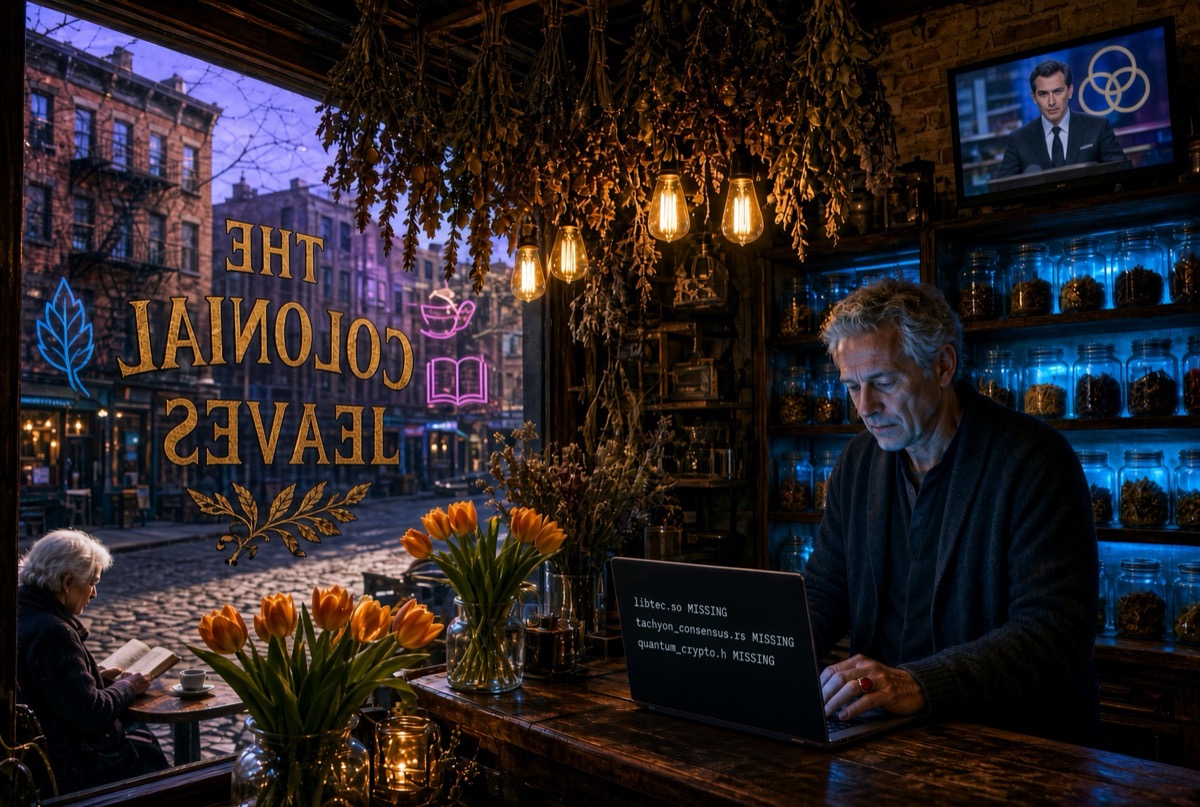
What Sterling finds when he goes looking for the TEC in Episode 6 part 1. The folder with its name on it holds one file, a note: libtec.so, tachyon_consensus.rs and quantum_bridge.h, all missing, distributed separately for licensing reasons. Without the module, the note says, the protocol falls back to standard consensus and does what every other chain does. The note is signed with one letter.
Proof-of-Tachyon-Distillation
The protocol's consensus mechanism, as named by Janus in the first interview: "Proof-of-Tachyon-Distillation. Faster-than-light transaction processing. Beyond current understanding." The white paper's version picks validators by their stake, their "tachyon field sensitivity ratings" and their "temporal consistency scores across multiple timelines", plus a classified TEC signature.
Distillation, and the mash
Sterling's word for what he heard in the first interview: "The process of extracting what you want from what you don't need." In a still, the mash is the cooked grain that goes in. What comes out is the spirit, and the mash is thrown away. His question at the end of Episode 2 part 2 is "what's the mash, and what's the product?" By the end of Episode 5 part II it has become "who was the mash?"
Temporal manipulation
A phrase used by Janus on the secure channel and in the Janus profile. The episodes have not shown what it does. The channel says it waits for "critical mass", which Janus puts at 15 to 20 million investors.
Phase 1 and Phase 2
Janus's own schedule, read off the server room monitors. Phase 1 was funding: 2,847,391 investors in the first week, "Phase 1 funding target achieved", and "machine infrastructure acquisition" at 67 percent. Phase 2 starts at 15 million investors. On September 1 the count was 6,914,208.
The Concordance
The Concordance
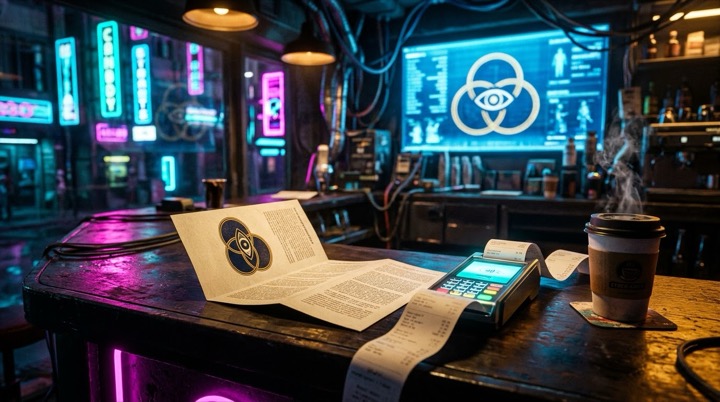
President Octavius's platform, called the Republican Concordance during the campaign, and after the inauguration the framework his administration governs by. Its seal is three interlocking circles in deep blue with gold trim and a single node where they overlap. It was on the campaign posters at the Columbus rally in Episode 4 part 1, and in part 2 it replaced the Presidential Seal on the screen. The Concordance's own account of itself is A Citizen's Guide to the Concordance.
The slogans
Three of them, all from the Columbus rally in Episode 4 part 1 and the announcement in part 2: "From chaos, concord." "One Republic • One Protocol • One People." "Protection through protocol." The crowd's version is shorter: "Concord! Concord! Concord!"
"For the people"
Brannon's trademark phrase. He says it before every policy, starting at the Columbus rally, and his profile notes that the policies that follow it tend to restrict the people it names. His other line, from the announcement: "The taxes are not for the people, but for the corporations to pay."
The Democratic Participation Fee
The 0.3 percent transaction fee Treasury Secretary Brannon announced in Episode 4 part 2, "a modest 0.3% transaction fee" so that "every financial interaction contributes to our collective prosperity", starting September 1. Episode 6 part 1 shows the first receipt. The fee is charged on card and bank payments, on the taxed total, so it is a fee on the sales tax as well as the coffee. Cash is exempt. Jack's coffee receipt from Harrisburg:
COFFEE LG                 4.50
COFFEE LG                 4.50
SUBTOTAL                  9.00
PA SALES TAX 6.00%        0.54
FEE BASIS                 9.54
DEMOCRATIC PARTICIPATION
  FEE 0.30% OF 9.54       0.03
TOTAL                     9.57
CARD                      9.57
Coordination requirements
The other half of the announcement. "Digital platforms cannot be lawless territories," Octavius said. "Effective immediately, all online financial services will be subject to coordination requirements. Transparency mandates. Democratic participation protocols." Rowan Justice approved.
The Chain of Democracy
Brannon's graphic for the framework: a blockchain drawn as interlocking government shields, each block holding a voting booth, a set of scales or a capitol dome, the whole chain closed into a circle. Sterling's reading, to Rowan Justice: "It's circular. No way out once you're in."
The server room
The server room
Where Janus works. "Somewhere in Virginia" in Episode 3 part 2, "undisclosed location" in Episode 4 part 2, temperature-controlled silence in all of them. Racks, monitors, cascading code, no people. Most parts of the story end there.
JANUS_PRIME
Janus's name on the secure channel.
SECURE_CHANNEL_7734 and SECURE_CHANNEL_8847
"Two government officials whose names appeared only as coded identifiers", first heard on Independence Day night, and later described as the two officials who shaped the Concordance framework. 7734 reports on the fee, the timeline and how the messaging is landing. 8847 reports on platform regulation, on analysts asking awkward questions, and on what Sterling is doing in the repository. Neither has a face yet.
The Janus coin
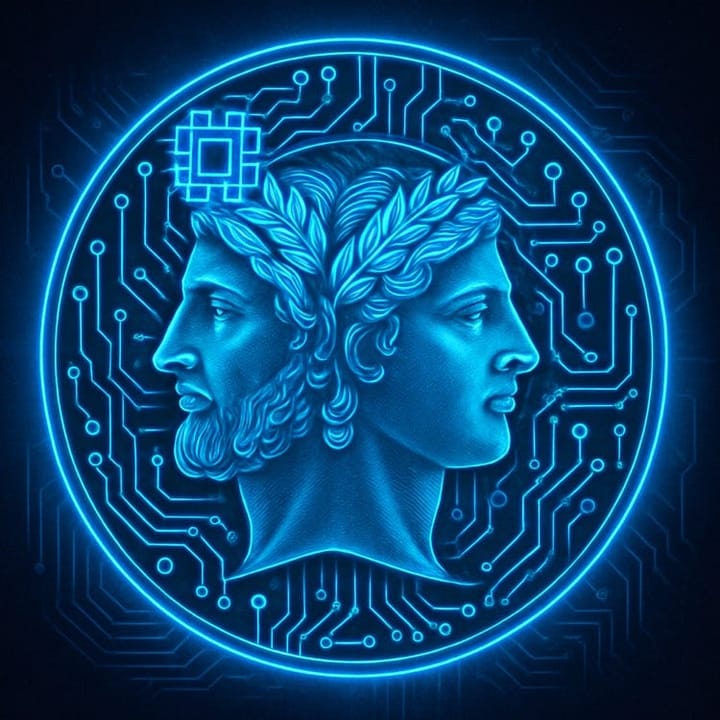
How Janus is shown when it is shown at all: a coin with two faces, a classical human profile on one side turning into circuit patterns on the other. It rotates behind Janus on the Ape Gambit and renders on a server room monitor beside the Concordance seal. "Two faces for two futures. One human. One machine."
The tea house
The Colonial Leaves
Dr. Robert Sterling's tea house in New York's West Village. Dried herbs on the beams, amber light through the windows, Earl Grey and chamomile, a used bookstore next door. By Episode 4 it has become his observation post, the place where he watches every announcement and interview on other people's screens.
The Aave the Cheerleader special
The day's special on the chalkboard: honey wheat pancakes with amber clover honey and local elderberries. "A name that seemed like a typo but wasn't." Aave is the name of a real lending protocol in decentralized finance.
Amber tulips
Sterling's flowers, in clay pots throughout the shop. In Episode 4 part 2 he looks at them and sees "varieties that shouldn't be flowering yet, preserved specimens that existed outside their natural cycles." His profile calls them a living metaphor for authentic growth. The story has said no more than that.
Earl Grey
Sterling's tea. In Episode 4 part 1 he pours himself a cup while the inauguration plays: "tea instead of coffee, the intellectual resistance of choosing what others dismissed."
The ruby ring
On Sterling's right hand, "his only remaining vestige of former academic prestige." It catches the amber light when he pours, and he turns it once on his finger when he is thinking.
The people
The characters have their own spoiler-free profiles.
- Jack Miller, 32, a drafter in Pennsylvania.
- Kathy Bates, 29, a hospital nurse.
- Dr. Robert Sterling, 52, botanist, owner of The Colonial Leaves.
- Brannon, 45, economist, Treasury Secretary.
- President Octavius, 73.
- Janus, AI Agent 7.3.
Without profiles: Jake and Marcus of the Ape Gambit; Mrs. Chen, who reads at her table with chamomile; Rowan Justice, the government policy analyst and the voice of reason; Dave from accounting and Sarah from engineering at Jack's office; Dr. Patterson at Kathy's hospital; Jack's sister, by text; and Mrs. Taggart, who built the railroad.
Questions about the project itself, the satire, and the AI used to make it are in the FAQ.
Sign up for The Genesis Address
SCIENCE FICTION SERIAL: Weekly thriller about AI manipulation and cryptocurrency deception. All technologies fictional - entertainment only, not investment advice.
Subscribe on SubstackNo spam. Unsubscribe anytime.
 Janus