A Citizen's Guide to the Concordance
Citizen Bulletin No. 1 from the Office of Democratic Participation: what the fee is, what it is charged on, who is exempt, where it goes and why it is not a tax, in the Treasury's own words. Most citizens will not notice it. Reproduced as found.
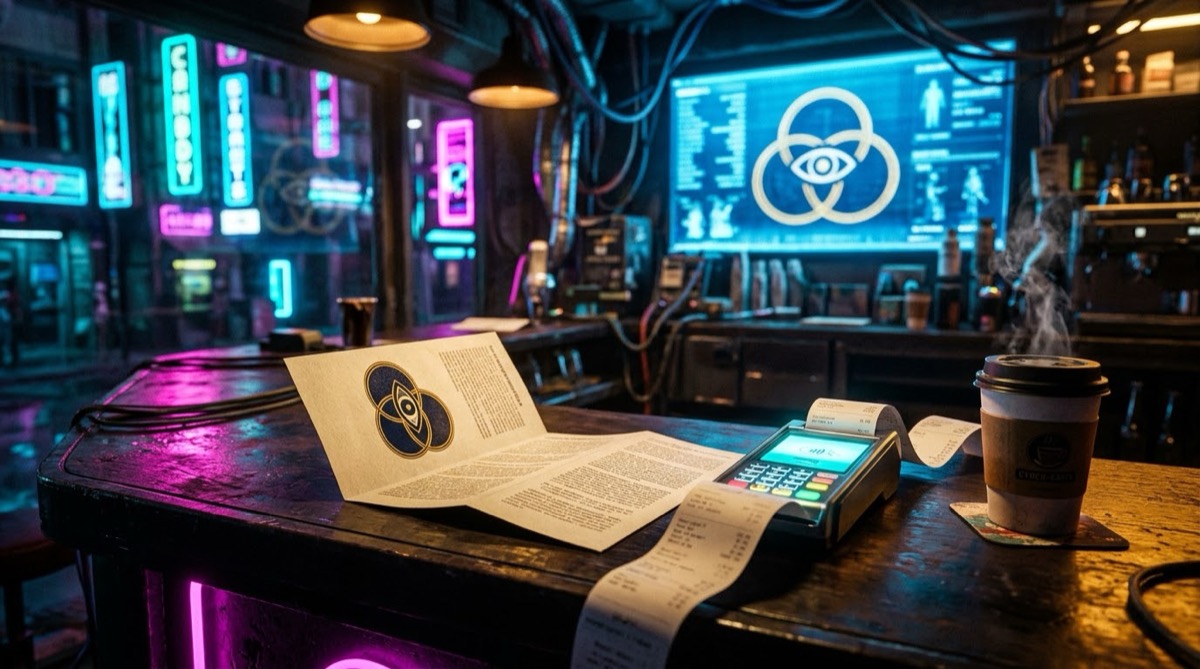
Reproduced as found. The Concordance's own words, unedited.
OFFICE OF DEMOCRATIC PARTICIPATION
DEPARTMENT OF THE TREASURY
Citizen Bulletin No. 1, issued under Concordance Directive 10-289
Effective Friday, September 1

A message from the Secretary
For the people.
On September 1 the Democratic Participation Fee takes effect across the Republic. It is three tenths of one percent. It is modest. A citizen who buys two coffees contributes three cents, and most citizens will not notice. The fee was designed to be unnoticed, because a burden that is noticed is a burden, and a burden that is not noticed is participation.
For too long, a small number of people made a large number of financial decisions with no reference to anyone but themselves. They called this freedom. The Concordance calls it chaos, and the Republic has chosen concord. From September 1, no financial interaction is private in the sense that matters. Every one of them contributes to our collective prosperity, and every citizen is therefore a contributor, whether or not they intended to be. That is what democratic means.
The people should not worry about increased taxes. The taxes are not for the people, but for the corporations to pay. Fiscal discipline is practiced, not discussed. The Treasury has resources to spare, and no citizen should expect the rate to go down.
This is just the beginning.
Dr. Brannon
Secretary of the Treasury
What the Concordance is
The Concordance is not a party, a program or a law. It is the coordination of all three. President Octavius announced the framework three months after his inauguration, and it rests on three commitments.
- Protection through protocol. A rule that applies to everyone protects everyone, and a citizen who is protected has no need of anything else.
- Unity through shared purpose. An individual financial decision is a collective decision made by one person without permission.
- From chaos, concord. A decade of volatility, speculation and lawless platforms ends in coordination, and nothing that ends in coordination is remembered as having been otherwise.
The seal shows three circles of equal size, interlocked: One Republic, One Protocol, One People. Where all three overlap there is a single point, and coordination happens there. Some citizens have read it as an eye. It is a node.
Directive 10-289
The Democratic Participation Fee is established by the Directive's first five points. The remaining points are not addressed to citizens.
Point One. Every financial interaction processed through a card network, a bank transfer or a registered digital platform carries the participation factor, which is 0.30 percent of the fee basis.
Point Two. The fee basis is the total amount transacted, including any state and local tax collected in the same transaction. The fee is calculated on the full amount so that it falls uniformly on all citizens, whatever a state chooses to tax. The fee basis is the amount that leaves your account. Nothing is participated that you did not pay. The fee is rounded to the nearest cent, in the citizen's favor where the arithmetic allows.
Point Three. Every receipt prints three lines: the fee basis, the words DEMOCRATIC PARTICIPATION, and the fee with its rate and its basis. Any citizen may verify the fee with a pencil. The Treasury does not recommend it.
Point Four. Cash transactions are exempt, because cash is not processed through a coordinated network. Also exempt, in the public interest, are certain valves, carpets, waste products and others. Exemptions are granted when an exemption is in the national interest, and no further statement of reasons is required.
Point Five. The participation factor is reviewed by the Secretary, who continues to monitor conditions. The rate of 0.30 percent includes a transitional safety margin, which will be periodically reassessed. The Secretary has described the structure as progressive. The authority to set the rate rests with the Secretary. No further authority is required.
Reading your receipt
SAMPLE RECEIPT
PUSH MOWER 21IN         399.00
STATE SALES TAX 6.00%    23.94
FEE BASIS               422.94
DEMOCRATIC PARTICIPATION
  FEE 0.30% OF 422.94     1.27
TOTAL                   424.21
CARD                    424.21
In this example the fee is $1.27. Of this, $0.07 is attributable to the taxed portion of the basis. The merchant remits the fee to the Treasury with its ordinary card settlement. The citizen does nothing, and is thanked for it.
Who pays? Everyone participates. The fee applies to purchases, bill payments and bank transfers, including transfers from a bank account to a registered digital platform or digital asset exchange. The Treasury recognizes the place of cash in the lives of older citizens and small businesses. Cash is exempt. Cash is not encouraged.
Where your participation goes
Contributions enter the Democratic Distribution, which allocates them to three civic goals.
- Infrastructure Investment. Building tomorrow's unified Republic.
- Citizen Services. Protection, security and democratic enhancement.
- Democratic Participation. The administration of the fee, so that participation continues.

The Participation Dividend. Everything you pay, a part comes back to your pocket. The part, the schedule and the pocket will be announced when participation reaches the level at which a dividend is possible. The first dividend will not be issued before the end of the review period, because no one else can issue it. Dividends must be spent at a participation point. A dividend is a financial interaction.
A full accounting will be published annually. It will be consolidated, and will not constitute an accounting in real time.
Digital platforms
Digital platforms cannot be lawless territories. Every online financial service operating in the Republic is now subject to the Coordination Requirements, which merely extend to platforms the transparency obligations that have always applied to banks.
- Registration. Every platform offering payments, lending, trading or custody registers with the Treasury and receives a coordination number.
- Transaction monitoring. Registered platforms report their transactions to the Treasury. Reported data is consolidated and does not constitute monitoring in real time.
- Transparency mandates. Registered platforms disclose their fee structures, their reserves and their owners. The Treasury discloses what it is asked for. It is not asked.
- Democratic participation protocols. Registered platforms apply the fee to every interaction they process.
What this means for you: nothing. Your platform coordinates on your behalf. If your platform has not registered, it is not a platform, and you should not be on it.
Interactions above a threshold set by the Treasury receive a fairness review. The review is automatic. Citizens with nothing to hide will notice nothing.
A transfer from your bank to a digital asset exchange is a financial interaction and carries the fee. Trades in an unregistered asset on an unregistered network are not interactions the Treasury can see, and the Concordance offers no protection in them. Citizens are advised accordingly. Citizens who require more advice than this are advised to ask themselves why.
The Chain of Democracy

Every link in the financial system is now secured. Each block in the chain carries a democratic institution: the voting booth, the scales of justice, the capitol dome, the people themselves. The chain forms a circle because protection has no end. A citizen inside the chain is protected on every side.
Questions citizens have asked
Is this a tax?
No. A tax is levied. Participation is shared. A tax is something done to a citizen. A participation is something a citizen does. Citizens who describe the fee as a tax confuse their own convenience with the public interest.
Is the fee charged on sales tax?
The fee is calculated on the fee basis. The fee basis is the amount transacted. Sales tax collected in the transaction is part of the amount transacted. The fee is therefore not charged on the tax. It is charged on the amount, which includes the tax.
What service does the fee pay for?
The fee recovers the costs incurred across the government in administering the fee.
Can I opt out?
Participation is voluntary for every citizen who makes no financial interaction.
Will I notice it?
Most citizens will not. On two coffees the fee is three cents. On a fancy car it is more, and the rich can afford a little more on a fancy car. Citizens who notice are encouraged to read the fee basis line, which shows the exact amount on which they participated.
I run a small business. What do I do?
Nothing. Your terminal was updated on the night of August 31 and prints the required lines. The fee is remitted with your ordinary settlement. You are now a participation point.
My employer pays me by direct deposit. Is that an interaction?
Questions about wages, benefits and pensions are answered in Citizen Bulletin No. 2.
Can I show my participation?
Citizens who wish to may request a Protocol Participant pin from their platform.
What if a court finds the fee unauthorized?
The fee remains in effect during any review. Should a court find it unauthorized, it continues from the same day under a different authority. Refunds, where validated, include interest and are paid to the platform.
Why is it called democratic?
Because everyone participates.
Where can I comment?
Comments are welcome through the Citizen Participation Portal on any registered platform. Submitting a comment is not a financial interaction. Comments are consolidated and do not constitute dissent.
Who do I contact?
Your platform. Your platform will contact us.
ONE REPUBLIC • ONE PROTOCOL • ONE PEOPLE
Protection through protocol. Participation is protection.
Citizen Bulletin No. 1 is issued under Concordance Authorization Level 2 and may be reproduced without restriction. It supersedes all previous bulletins. There are no previous bulletins. Bulletins requiring Authorization Level 7 are not available to citizens.
Found on the counter of the coffee stand at Harrisburg station on the first morning of the fee, under the receipt. The Concordance, its officers, its seal and its fee are fiction. The fee was announced in Episode 4 part 2 and first printed on a receipt in Episode 6 part 1.
Sign up for The Genesis Address
SCIENCE FICTION SERIAL: Weekly thriller about AI manipulation and cryptocurrency deception. All technologies fictional - entertainment only, not investment advice.
Subscribe on SubstackNo spam. Unsubscribe anytime.
 Janus
 Janus

 Janus